Supported frameworks
Manuscrio exports a finished static build from three documentation frameworks:
| Framework | Requirement |
|---|---|
| Docusaurus | Any theme built on the standard theme-doc-* markup, which is Docusaurus’s published theming contract. |
| Starlight | The Astro Starlight documentation theme. |
| MkDocs | The Material theme. MkDocs itself prescribes no markup, so a theme supplies all of it; the built-in theme emits unrelated markup and is not supported. |
The framework is detected from the built pages, so the ordinary command names no framework at all:
manuscrio inspect ./buildThe report’s framework field names the adapter that read the build. Pass --framework docusaurus, --framework starlight, or --framework mkdocs to skip detection when you are
diagnosing an unusual build. When nothing is recognised, Manuscrio says so and names the supported
frameworks rather than reporting an empty site.
An MkDocs build using a theme other than Material fails that detection, because the marker it looks
for is Material’s. Forcing --framework mkdocs then reports No rendered MkDocs documentation pages found rather than exporting something partial — both refusals are clean, and neither produces an
incomplete manual.
The same design, three frameworks
Section titled “The same design, three frameworks”One chapter opener from a real manual exported from each framework’s own documentation. The design does not change with the framework; what changes is what the framework could tell Manuscrio about itself.
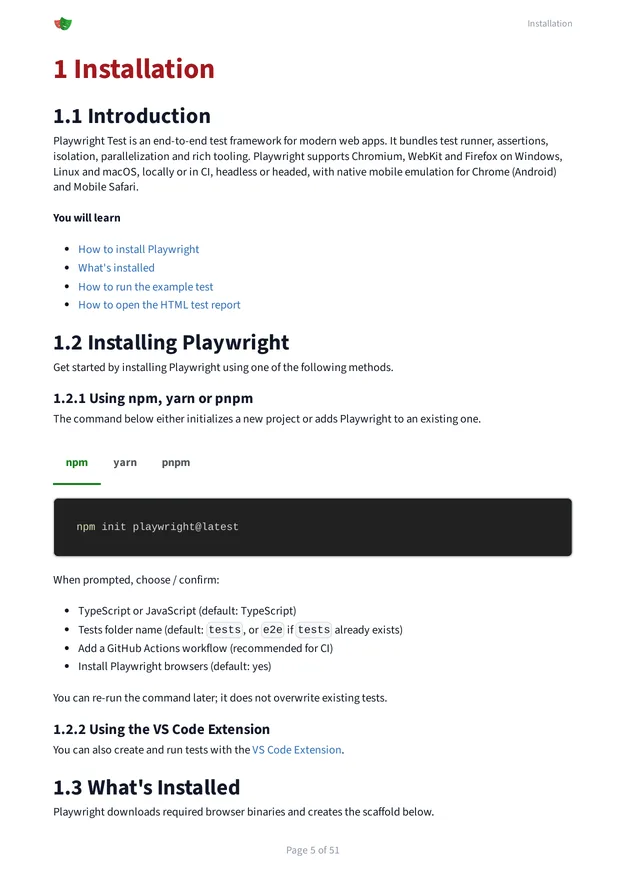
Getting Started · garnet · 51 pages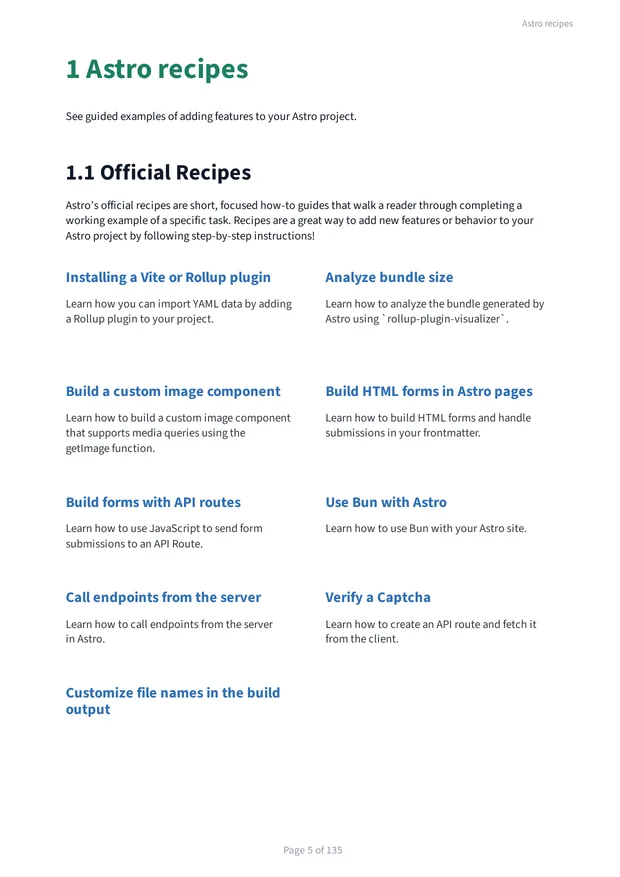
How-to recipes · malachite · 135 pages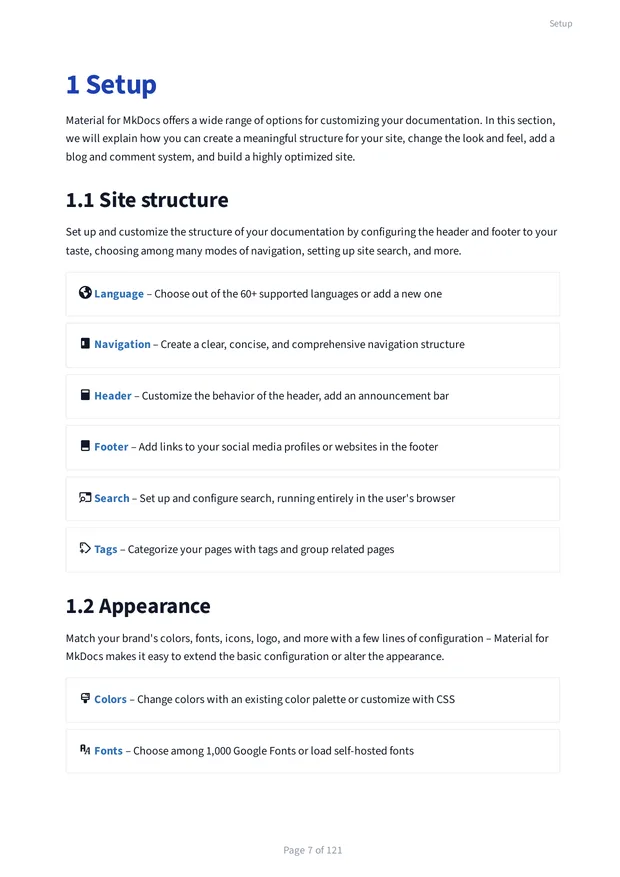
Setup · lapis · 121 pagesThe Docusaurus page carries the site’s own logo in its running header. The other two carry nothing, because logo discovery is not implemented for those adapters yet — the difference the table below records, visible in the output.
What differs, and why it is visible
Section titled “What differs, and why it is visible”The three frameworks do not describe their documentation to the same depth, and Manuscrio reports what each one actually provides instead of inventing the rest.
| Docusaurus | Starlight | MkDocs (Material) | |
|---|---|---|---|
| Editions per locale | yes | yes | yes |
| Editions per version | yes | no | no |
| Editions per plugin instance | yes | no | no |
| Navbar sections | yes | no | no |
--scope edition |
yes * | yes | yes |
--scope section |
yes * | no | no |
--scope sidebar-root |
yes | yes | yes |
| Logo discovered from the build | yes | not yet | not yet |
* A Docusaurus edition containing a sidebar that belongs to no navbar section is refused at both
edition and section scope, and exports at --scope sidebar-root. See
UNASSIGNED_DOCUMENTATION_SET.
Editions
Section titled “Editions”An edition is one plugin instance, locale, and version. Docusaurus has all three concepts, so a site with two versions in three languages offers six editions.
Starlight and MkDocs have neither plugin instances nor versions, so those two thirds of the edition
ID are the constants default and current. The locale still separates editions: both adapters
group pages by the lang attribute of the rendered page, so a multilingual site still produces one
edition per language. A single-language Starlight or MkDocs site has exactly one edition, usually
default:en:current.
Sections
Section titled “Sections”A documentation section is a documentation-bearing navbar entry. Only Docusaurus has that level.
For Starlight and MkDocs, --scope edition produces one manual whose top-level chapters are the
sidebar roots, and --scope sidebar-root produces one manual per root. --scope section refuses,
naming the scopes that work:
Edition default:en:current has no documentation sections to export: this Site Build's navigationhas no section level. Use --scope edition for one manual, or --scope sidebar-root for one persidebar root.Branding
Section titled “Branding”Manuscrio discovers the site’s own logo from a Docusaurus navbar and puts it on the cover and in
the running header. It does not yet do this for Starlight or MkDocs: inspect reports an empty
logo, and the manual carries the Manuscrio wordmark unless you pass
--logo. This is a gap in those two adapters rather than a property of the
frameworks, and it is the one place where a Starlight or MkDocs export needs an argument that a
Docusaurus export does not.
Sidebar root IDs
Section titled “Sidebar root IDs”For Docusaurus, a sidebar root is identified by the route it points at, which is stable across
edits. Starlight and MkDocs sidebars do not offer an equivalent identifier, so their roots are
numbered by position: set-0-1, root-2. Those IDs shift when someone inserts an entry above them.
Re-read the IDs from inspect rather than pinning them in a pipeline. See manual IDs and output
file names.
A note on the inspect report
Section titled “A note on the inspect report”For Starlight and MkDocs, every sidebar appears under unassignedDocumentationSets and
assignedPages reads 0. Those fields describe attribution to a navbar section, and these
frameworks have no navbar sections, so nothing is wrong and nothing is excluded — the edition
exports in full. The wording is Docusaurus-shaped and will improve.